Never Forget a Connection: How AddNow's Smart Reminders Work
Your brain forgets people fast. Smart reminders fix that. Learn the tiered follow-up system that turns fading connections into lasting relationships.

TL;DR: You don't forget people because you're flaky — memory just isn't built to keep hundreds of loose connections warm on willpower alone, and the specific stuff (a name, a small personal detail) is exactly what's most often forgotten. The fix is a tiered cadence — core contacts every week or two, the wider circle monthly to yearly — paired with a one-line note about the small personal stuff, so when a reminder fires you already know what to say. AddNow handles the when.
I have a confession: last year I met someone amazing at a conference. They had this brilliant idea about... honestly, I can't remember anymore. Which is exactly my problem. I got their contact info, told myself I'd follow up, and then my calendar exploded and six months disappeared. By the time I remembered, it didn't feel like "hey, let's collaborate" — it felt like "please don't block me for ghosting."
Now contrast that with this: I ran into a former colleague at an industry event, someone I'd had maybe two conversations with, three years earlier. Within thirty seconds she asked how Biscuit was doing — my dog, mentioned exactly once, in passing, at a team lunch in 2022. She remembered his name, his breed (corgi mix), and his habit of stealing socks off the laundry pile.
I stood there stunned — not supernatural, just someone who'd actually listened. That one detail did more for the relationship than a hundred "let's circle back" emails ever could.
Her secret: she keeps notes. Thirty seconds after every meaningful conversation, she jots down the small stuff — the dog's name, the side project someone's excited about. When a reminder fires, she skips the generic "hope you're well" and sends "how's Biscuit doing with the sock situation?" It lands every time.
That's the gap between remembering to follow up and following up in a way that actually matters. The first is a calendar event. The second is an act of intention. Most relationships die quietly in that gap.
Why Your Brain Fails at Networking (And Why That's Okay)
Your memory isn't broken — it just wasn't built for this. Humans evolved to track a small, stable tribe, not hundreds of contacts scattered across a decade of jobs and conferences. Without repeated contact, what you learned about someone erodes fast, and unevenly.
Diary research on real memory lapses — psychologist Devin Ray had about 50 people log every time they realized they'd forgotten something about someone else, over two weeks — found specific details vanish far more than anything else: 48% of logged incidents involved personal details, especially with acquaintances. Complete failures — not recognizing someone at all — were rare, at 9%. You rarely forget that you met someone — you forget the detail that would have made reaching back out feel natural.
That's not random. A 1987 British Journal of Psychology study by Kim McWeeny and colleagues — origin of the "Baker/baker paradox" — showed subjects the same unfamiliar face paired once with an occupation ("he's a baker") and once with a surname ("Mr. Baker"). Same word, same face. The occupation stuck; the name evaporated. Gillian Cohen's 1990 follow-up explains why: names are arbitrary labels with no semantic hook, while an occupation or hometown connects to things you already know. Your brain isn't punishing acquaintances — it's doing what memory always does with meaningless-looking information, and a name is about as meaningless-looking as it gets.
The decay itself follows a predictable shape. Hermann Ebbinghaus mapped the forgetting curve in the 1880s: in his original data, the savings measure fell to about 44% after an hour, 34% after a day, and 21% after a month, then leveled off. A 2015 replication reproduced the shape — its one-month figure was even lower. Ebbinghaus tested nonsense syllables, not people, so read those numbers as a shape, not a schedule — but the shape is the whole argument here: your system has to intervene early, not months later when there's nothing left to refresh.
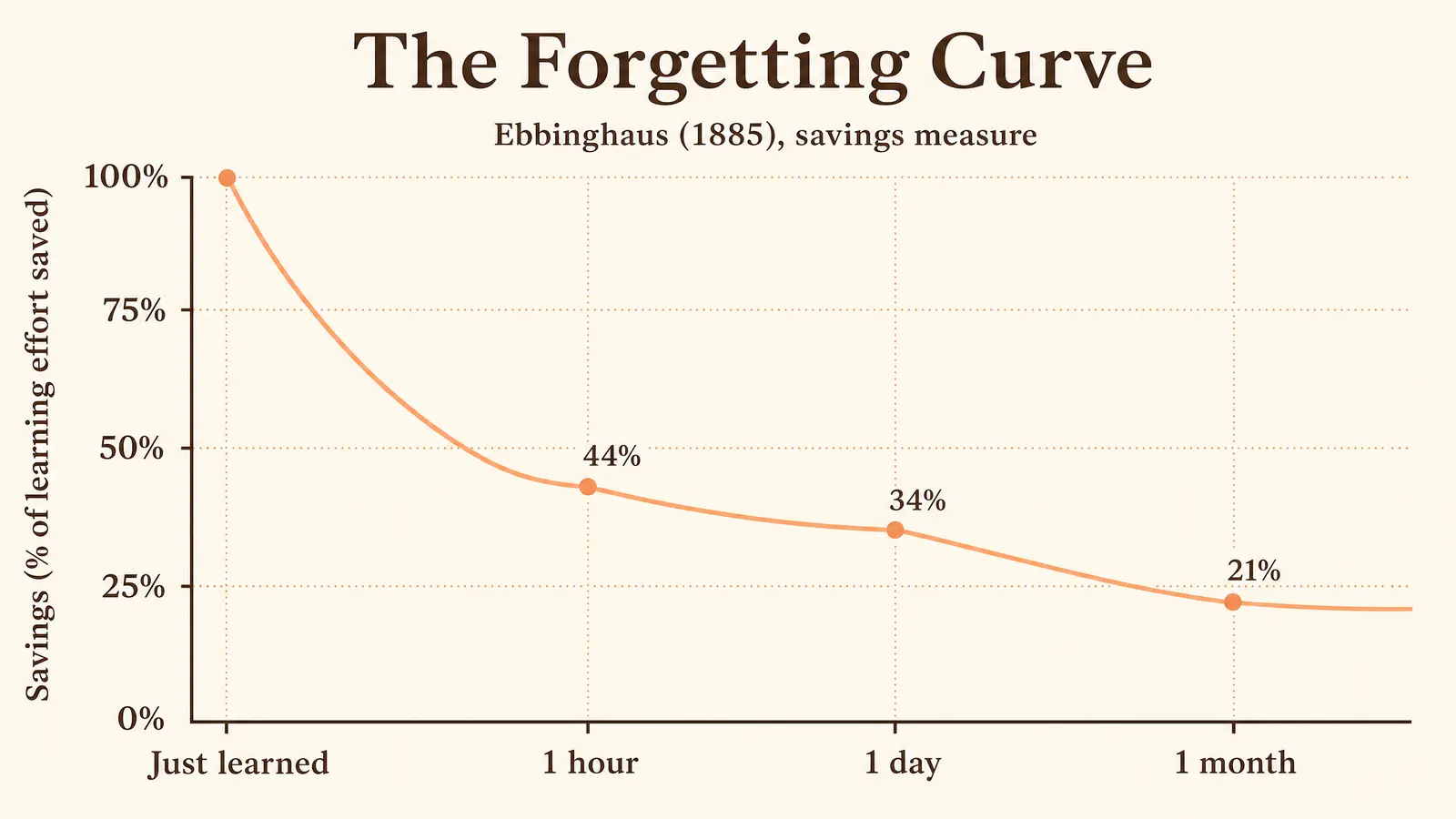
It's not laziness. It's how memory behaves when nothing reinforces it.
- Within a few weeks of no contact, the specific details start slipping — the dog's name, the project, the thing you bonded over
- Give it a month or two and a real connection quietly demotes to a face you vaguely recognize
- Let a season pass and reaching out starts to feel awkward instead of natural
The solution isn't willpower. It's structure.
The Framework: How to Actually Remember People
The trick is to stop treating every contact the same. Relationships sit at different distances, and each needs a different rhythm to stay warm. Here's a simple way to think about it:
The Optimal Reminder Schedule
Different relationships need different contact frequency. Here's the framework professionals use:
Tier 1: Core Network (Your Most Important Relationships)
- Contact frequency: Weekly or bi-weekly
- Examples: Close collaborators, key mentors, trusted advisors
- Purpose: Deep relationships that drive most of your opportunities
- Why this timing: More frequent contact prevents drift and maintains top-of-mind awareness
Tier 2: Active Network (People You Want to Build With)
- Contact frequency: Monthly
- Examples: Recent connections, peers in your field, promising leads
- Purpose: Turn potential into actual relationships
- Why this timing: Monthly is the sweet spot — often enough to seem intentional, not so often you're annoying
Tier 3: Extended Network (Broader Professional Circle)
- Contact frequency: Quarterly (every 3 months)
- Examples: Conference acquaintances, past colleagues, industry contacts
- Purpose: Keep the relationship warm without heavy maintenance
- Why this timing: Quarterly prevents awkwardness while maintaining relationship status
Tier 4: Seasonal Network (Annual Check-ins)
- Contact frequency: 1-2 times per year
- Examples: Old friends, distant connections, former clients
- Purpose: Show you still value the relationship despite time gaps
- Why this timing: Annual prevents complete relationship decay
What Actually Happens When You Use This System
When you follow this framework, the arc of a relationship tends to look something like this:
- Right after a good conversation: the interaction is fresh and the person remembers you fondly
- A few weeks of silence: the details start to fade and the relationship quietly cools
- A well-timed check-in: you reconnect before things go cold, so it feels natural instead of awkward
- Over the long haul: a pattern of consistent contact makes you the person who's reliable and stays in touch
The intuition here mirrors spaced repetition: a 2019 Journal of Neuroscience study led by Kanyin Feng found that revisiting something at spaced intervals strengthens memory far better than cramming it all at once. Relationships behave the same way.
Making the System Work in Practice
The challenge isn't knowing when to reach out — it's actually remembering to do it. Tools like AddNow track contact dates and send timely reminders, part of a broader shift toward AI tackling the relational memory problem and acting as a genuine networking assistant. It doesn't build the relationship for you — it just makes sure you never forget one needs tending. When the reminder comes, you can focus on what to say instead of when you last talked.
How to Implement This Framework Today
Here's how to get started with systematic relationship maintenance:
Step 1: Categorize Your Existing Contacts
Go through your current contacts and assign them to tiers. Be honest — not everyone needs to be Tier 1. Most people will fall into Tier 3 or 4, and that's fine. If your list is too chaotic to even attempt this, organize it first; tiering is easy once you can see what you're tiering.
Quick categorization criteria:
- Tier 1: Would you reach out to them for career advice or help with a major decision?
- Tier 2: Do you see potential for future collaboration or mutual growth?
- Tier 3: Is this someone you want to keep in your network long-term?
- Tier 4: Would you be happy to reconnect if the opportunity arose?
Step 2: Add Context Notes
For each contact, write a brief note about:
- How you met
- What you talked about
- Their current focus or interests
- Any specific details they shared (projects, challenges, goals)
This takes 30 seconds per person but saves you minutes of mental recall later.
Step 3: Set Up Your Reminder System
You need a system that:
- Tracks when you last contacted each person
- Reminds you based on your tier schedule
- Shows you the context notes when it's time to reach out
You can do this with a spreadsheet and calendar reminders, or a tool built for it (AddNow's smart reminders do this automatically, learning your patterns and suggesting when to reconnect).
Step 4: When Reminders Come, Act
The reminder is only valuable if you actually reach out. Even a brief message counts:
- "Saw this article about [topic you discussed] and thought of you"
- "How's [project they mentioned] coming along?"
- "Been thinking about our conversation about [topic] — curious how you're thinking about it now"
Measuring Success
Track these metrics to see if the system is working:
- Response rate: Are people responding when you reach out?
- Reciprocation rate: Are they reaching out to you proactively?
- Opportunity rate: Are connections leading to collaborations, introductions, or opportunities?
If most of your messages get a reply, you're doing well. If they mostly land in silence, your outreach might feel too generic or forced — lead with the specific detail, not the "just checking in."
The Compounding Returns
Here's what happens over time when you stick with this system:
Month 1-3: You're rebuilding connections. Some people are surprised to hear from you (in a good way).
Month 4-6: Relationships start feeling natural again. People begin reaching out to you unprompted.
Month 7-12: Your network becomes a real asset. Opportunities start coming through your connections.
Year 2+: People think of you as someone who "stays in touch" and "builds real relationships." This reputation becomes one of your professional differentiators.
The difference between someone with a strong network and someone without one isn't natural charisma — it's systematic follow-up.
Start small. Pick 5-10 people in your Tier 1 or Tier 2 and commit to reaching out this month. Build the habit, then scale up.
Your future self will thank you for starting today.
Download AddNow to put this system on autopilot, or see how Buddy's AI layer handles the remembering for you.
Sources
- Ray, D. (2018). How often do people forget things about one another? The Conversation. — link
- McWeeny, K. H., et al. (1987). Putting names to faces. British Journal of Psychology, 78(2). — link
- Cohen, G. (1990). Why is it difficult to put names to faces? British Journal of Psychology, 81(3). — link
- Murre, J. M. J., & Dros, J. (2015). Replication and Analysis of Ebbinghaus' Forgetting Curve. PLoS ONE, 10(7). — link
- Feng, K., et al. (2019). Spaced Learning Enhances Episodic Memory by Increasing Neural Pattern Similarity Across Repetitions. Journal of Neuroscience, 39(27). — link
Written by
AddNow Team
October 15, 2025
Share this article