Dunbar's Number and Networking: What the Research Says
Dunbar's 150 is an extrapolation, not a measured fact — and it's contested. Here's the real research, and how the layers help prioritize your network.
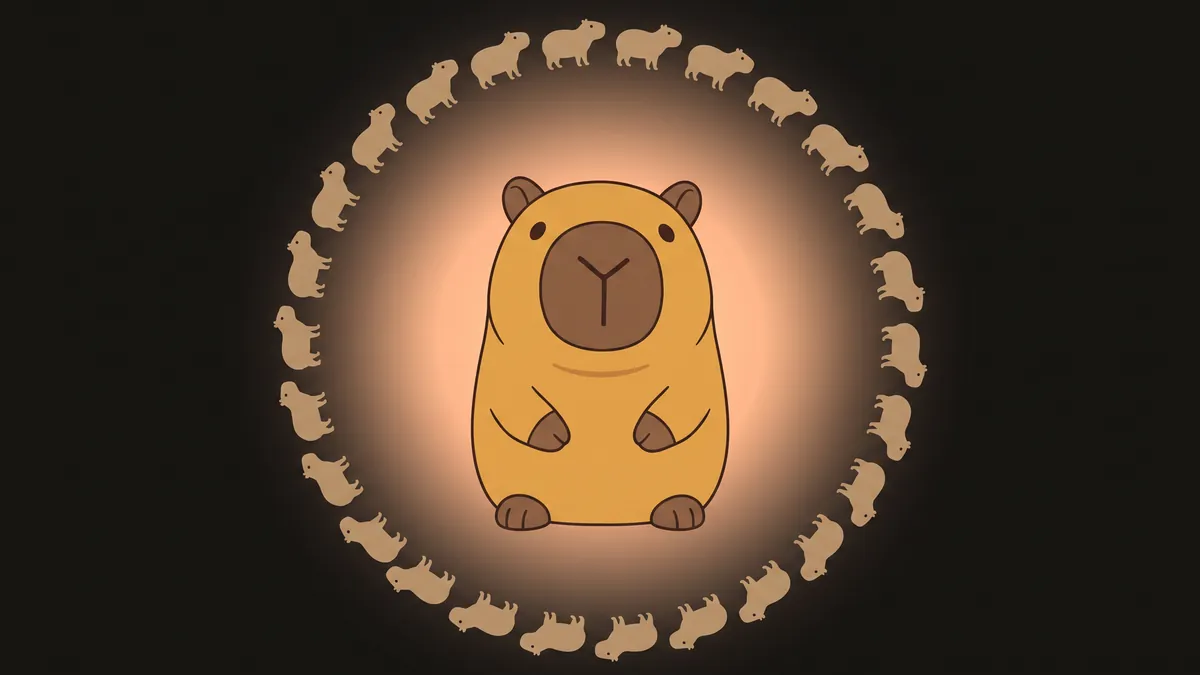
TL;DR: Dunbar's number — the famous "150 relationships" figure — comes from a 1992 regression across primate species, not from any study of human social networks or social media. The popularized layers of 5, 15, 50, and 150 are also less precise than usually presented: the actual data show ranges (roughly 3-5, 9-15, 30-50), and 150 specifically is an extrapolation, not an observed figure. The number is genuinely contested — a 2021 reanalysis found the statistics behind it too weak to support any single figure — yet large-scale digital-behavior data keeps landing in roughly the predicted range anyway. For networking purposes, the tiered structure matters more than the exact count: it's a useful way to decide who gets your limited attention.
Someone in almost every conversation about team size, community management, or "how many people can you really know" eventually says "150 — it's Dunbar's number." It gets cited like a settled physical constant, the social-science equivalent of a boiling point. Slack channels get capped at it. Conference talks reference it. Networking advice leans on it as justification for keeping your circle small.
It usually gets invoked to justify a decision that was already made for other reasons. A manager wants to cap headcount, a strategist wants to argue against sprawling online communities, a networking coach wants to tell you to stop collecting LinkedIn contacts — and Dunbar's number gets reached for as the scientific seal of approval.
Almost none of that citing bothers to ask where the number actually came from, or whether it means what people assume it means. It's worth knowing, because the honest answer is more interesting — and more useful for networking — than the tidy version everyone repeats.
Where Does the Number 150 Actually Come From?
It doesn't come from a study of human social networks, LinkedIn connections, or friendship surveys. Robin Dunbar's original 1992 paper is a regression across dozens of primate species, relating the relative size of each species' neocortex to the size of the social groups it forms in the wild. Dunbar's argument was that neocortex capacity limits how many relationships an individual can track simultaneously, and that groups exceeding that capacity tend to become unstable and fragment.
Human group size, in this framework, isn't something anyone counted directly. It's a prediction — where humans should fall, extrapolated from the primate curve, given human neocortex size. That's a legitimate scientific method, but it's a different thing than a survey of how many friends people actually have, and the distinction matters for how much weight the number deserves.
This kind of cross-species regression is a standard, respected tool in evolutionary biology — comparing a trait across many related species to infer something about one species you can't directly test the same way. Nobody could ethically run a controlled experiment capping how many stable relationships a person is allowed to have and observe the results. The regression approach is a reasonable way around that limitation. But it also means the human number was never an observation; it was always an extrapolated point on a curve fitted from other species' data, which is exactly the detail that gets lost every time someone cites "150" as if a census had produced it.
The Layers Aren't as Clean as "5, 15, 50, 150"
The popular version of Dunbar's number isn't just 150 — it's a nested structure, usually quoted as tidy layers of 5, 15, 50, and 150. That framing comes from a 2005 follow-up paper by Zhou, Sornette, Hill and Dunbar, and it's worth being precise about what it actually found.
The observed layers aren't round numbers — they're ranges: roughly 3 to 5 people for what the paper calls a "support clique," 9 to 15 for a "sympathy group," and 30 to 50 for a band-sized grouping. The 150 figure sits outside all of that measured data — it's the paper's extrapolation for the outer "acquaintance" layer, not a range anyone directly observed in the dataset. The popularized 5/15/50/150 shorthand isn't wrong, exactly. It's a rounding of ranges, and the biggest, most-quoted number in the set is also the least directly measured.
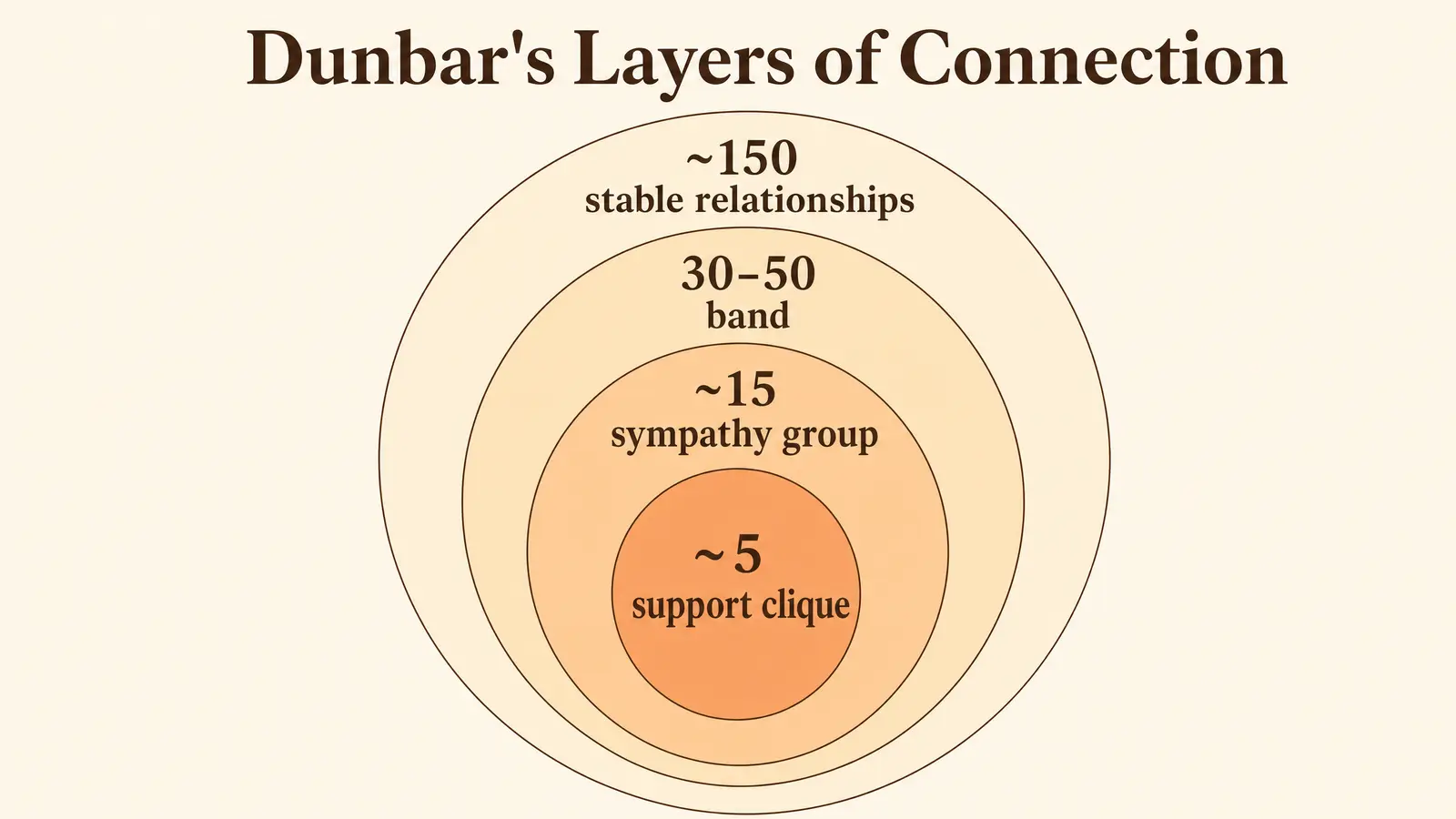
In plain terms, the layers roughly track how most people already sort their relationships without a name for it: the innermost handful are the people you'd call at 2 a.m. without hesitating, the next band are close friends you make a real effort to see, and the outer band are people you're genuinely friendly with but wouldn't necessarily prioritize over everything else going on in your life. The 150 is meant to be the largest group beyond that — the outer edge of people you could still put a name to a face for and recall some shared context, even without actively maintaining the relationship.
Is Dunbar's Number Even Real? The Case Against It
That extrapolation is also the most contested part of the whole idea. In 2021, Stockholm University researchers Lindenfors, Wartel and Lind published a reanalysis in Biology Letters that re-ran Dunbar's original statistical method and found it produces confidence intervals too wide to mean much — in their reanalysis, ranges as wide as 3.8 to 520, and separately 2.1 to 336. Their conclusion is blunt: "specifying any one number is futile," and they argue a cognitive limit on human group size "cannot be derived in this manner" from the original regression approach.
To translate the statistics: a confidence interval that wide is functionally an admission that the underlying regression can't pin down a number with any real precision. An interval of 3.8 to 520 isn't a tight range around 150 — it comfortably contains numbers ten times smaller and ten times larger than the figure everyone quotes. That's the specific, technical basis for the critique. It isn't "some scientists disagree" in a vague sense; it's a direct challenge to whether the original method could ever have produced a trustworthy number in the first place.
It's worth being precise about who's making this argument, because it's often mischaracterized as Dunbar revising his own claim. It isn't. Robin Dunbar is not an author on this paper. It's outside researchers challenging the statistical method that produced the 150 figure in the first place — a real scientific critique, not a reversal from within.
The Case That It Holds Up Anyway
Here's what makes this genuinely a live debate rather than a settled takedown: independent evidence for roughly the same range predates the 2021 critique. A 2011 study of 1.7 million Twitter users, analyzing six months of actual conversational activity, found that despite a platform with no built-in cap on who you can follow, sustained back-and-forth exchanges clustered around 100 to 200 people per user — landing squarely inside Dunbar's predicted range. The researchers described this as the "economy of attention" being limited online by the same cognitive and biological constraints Dunbar's theory predicted, not by anything specific to Twitter's design.
What makes the Twitter finding notable is that it wasn't looking for Dunbar's number specifically — it was studying how attention gets allocated on a platform explicitly designed to let people follow as many accounts as they want. If human cognitive limits were irrelevant online, there'd be no obvious reason for sustained activity to cluster in a narrow band at all. The fact that it did, independently of any deliberate cap, is a different and arguably stronger kind of evidence than a self-reported survey would be.
So the honest state of the science is two things at once: the specific statistical method behind the number has been credibly challenged, and separate, large-scale digital-behavior data keeps landing in roughly the range the theory predicts anyway. Neither side gets to declare a clean win here, and treating the debate that way is more accurate — and more interesting — than picking a side for the sake of a tidy conclusion.
Why Would a Limit Like This Exist at All?
Even setting aside the exact figure, the underlying idea has a plausible mechanism behind it. In a 1993 follow-up paper, Dunbar extended the same neocortex-to-group-size logic to argue that human language itself may have evolved partly as a more time-efficient substitute for the physical grooming primates use to maintain social bonds — a way of servicing more relationships than one-on-one grooming time would ever allow.
Grooming, in primate social bonding, isn't just hygiene — it's a slow, one-on-one act that reinforces trust and alliance, and it doesn't scale; you can only groom one animal at a time. Dunbar's argument is that language let humans do something functionally similar — signal investment in a relationship, exchange social information, reinforce a bond — without the one-to-one time cost, which is part of why human social groups could plausibly run larger than other primates' even with broadly similar underlying cognitive machinery. Whether or not 150 is the right number, the broader claim that maintaining relationships consumes finite cognitive and time resources isn't really in dispute.
How to Actually Use the Layers for Networking
The debate over the exact figure matters less for networking than the tiered structure underneath it. Even if 150 turns out to be off by a wide margin, the idea that relationships naturally sort into a small number of maintenance tiers — a handful of people you're close to, a wider circle you check in with deliberately, and a much larger set of people you can recognize but can't realistically maintain — is a genuinely useful way to decide where your limited time should go.
The middle tier is where most networking value actually gets created: the moderate-strength ties that drive an outsized share of job mobility live there, not in your innermost circle. That's also why the case for treating quality as more valuable than raw contact count follows fairly directly from a fixed-capacity model of attention — you genuinely cannot maintain everyone at the same depth, so the question is which tier each relationship belongs in, not how to expand the tiers themselves. One of the most common networking mistakes is failing to make that distinction at all — treating a person you talk to weekly and someone you met once at a conference as if they warranted the same effort. And if maintaining a wide outer layer doesn't come naturally to you in the first place, a more introvert-friendly approach to networking leans into fewer, deeper tiers instead of fighting your own bandwidth.
A simple way to start: instead of one undifferentiated contact list, sort people into three rough bands — who you'd want to know about immediately if something changed in their life, who you'd want to know about eventually, and who you're fine hearing about only when you happen to cross paths. Most contact apps don't make this distinction easy, which is exactly why most people never do it and end up treating every relationship as either fully active or fully forgotten, with nothing in between.
None of this requires the number 150 to be exactly right. It requires accepting that attention is finite, tiers are real, and most people manage their network as if every contact belonged in the same one. Keeping track of which tier someone actually falls into — and noticing when they've quietly drifted into a lower one — is a bookkeeping problem as much as a psychological one. AddNow is built for exactly that layer of the problem: not expanding how many people you can meaningfully know, but making sure the limited attention you do have goes to the right tier instead of whoever happens to cross your mind.
Sources
- Dunbar, R. I. M. (1992). Neocortex Size as a Constraint on Group Size in Primates. Journal of Human Evolution, 22(6), 469–493. — link
- Zhou, W.-X., Sornette, D., Hill, R. A. & Dunbar, R. I. M. (2005). Discrete Hierarchical Organization of Social Group Sizes. Proceedings of the Royal Society B, 272(1561), 439–444. — link
- Lindenfors, P., Wartel, A. & Lind, J. (2021). "Dunbar's Number" Deconstructed. Biology Letters, 17(5), 20210158. — link
- Gonçalves, B., Perra, N. & Vespignani, A. (2011). Modeling Users' Activity on Twitter Networks: Validation of Dunbar's Number. PLoS ONE, 6(8), e22656. — link
- Dunbar, R. I. M. (1993). Coevolution of Neocortex Size, Group Size and Language in Humans. Behavioral and Brain Sciences, 16(4), 681–694. — link
Written by
AddNow Team
May 28, 2026
Share this article