Moderately Weak Ties Are What Actually Get You Hired
A 2022 Science study of 20 million LinkedIn users found moderately weak ties—not close friends—drive job mobility. How to keep those ties from going cold.

TL;DR: The connections most likely to land you a job aren't your closest contacts or total strangers — they're the moderate-strength ties in between: former colleagues and industry peers who know your work but move in a different world. A 2022 Science study of 20 million LinkedIn users confirmed it. The catch is that these are exactly the relationships that quietly decay without active maintenance, so the real edge is having a system that keeps them from going cold.
Think About Your Last Job
Not the application. The introduction.
If you trace it back — past the interview, past the referral call, past whoever sent your resume to the hiring manager — you probably land at someone you hadn't spoken to in months. Not your best friend. Not a stranger. Someone in the middle: a former colleague from two jobs ago, a college acquaintance who moved into a different industry, a conference contact you'd met twice and stayed loosely connected with on LinkedIn.
That person, the one you almost didn't message because you weren't sure they'd remember you, did more to change your career trajectory than the people you talk to every week.
This isn't coincidence. It's sociology — and it's also, as it turns out, exactly why your contact list is one of the more undervalued assets you own: the people driving your next opportunity are already in it, quietly going cold.
Granovetter's Original Insight
In 1973, Stanford sociologist Mark Granovetter published a deceptively simple study, later formalized in his paper "The Strength of Weak Ties": he asked recently hired white-collar workers how they had found their jobs, then mapped the strength of the relationships involved.
The finding was counterintuitive. The majority of successful hires came not through close friends — people they saw regularly and confided in — but through acquaintances: people they saw only occasionally, sometimes just a few times a year.
Granovetter's explanation was structural. Strong ties, by definition, tend to cluster. Your close friends know the same people you know, work in the same companies you've considered, move in the same professional circles. When you ask them for a job lead, they reach into the same information pool you already have access to.
Weak ties, by contrast, bridge. They connect you to entirely different clusters — different industries, different cities, different companies, different hiring managers. When an acquaintance recommends you for a role, they're giving you access to a world your strong ties can't reach.
Granovetter called this "the strength of weak ties," and it became one of the most cited findings in sociology. But he was working from a small sample and a simpler economy. Testing it at scale had to wait nearly fifty years.
What the MIT Study Actually Found
In 2022, researchers Karthik Rajkumar, Guillaume Saint-Jacques, Iavor Bojinov, Erik Brynjolfsson and MIT's Sinan Aral used a natural experiment at LinkedIn to test Granovetter's theory at a scale he never could have imagined. The study, published in Science and summarized by MIT News, analyzed data from 20 million LinkedIn users over a five-year period, looking at how the strength of professional connections correlated with actual job transitions.
The results refined Granovetter's model in an important way.
It was not the weakest ties that drove the most job mobility. Connections with almost no mutual contacts — true cold links — performed no better than strong ties. What mattered was the middle: connections with around ten mutual contacts — what the researchers called "moderately weak" ties. Not strangers, not close friends. Former colleagues, industry peers, people you'd worked alongside briefly and maintained a loose but real connection with.
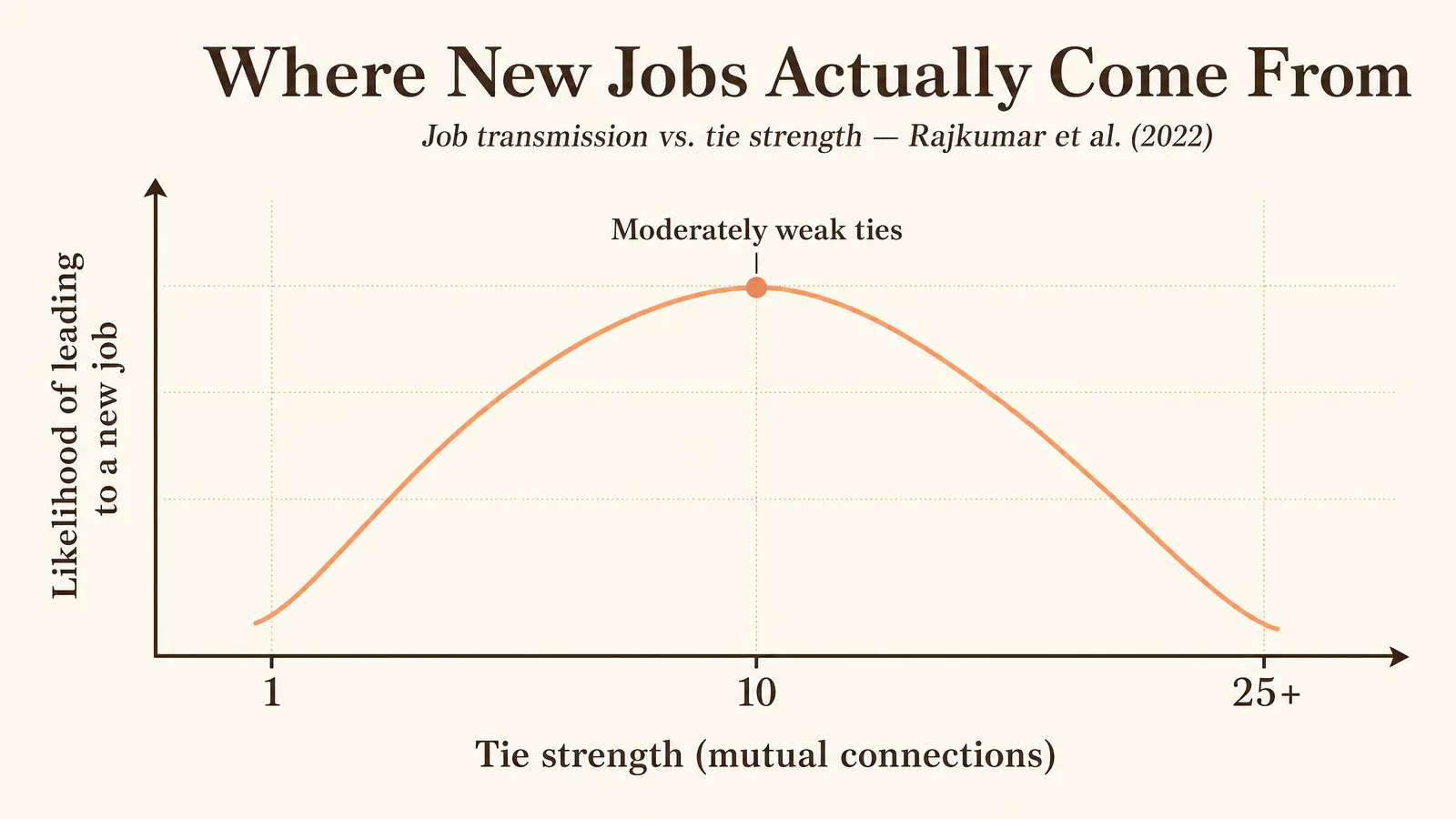
As lead author Sinan Aral put it: "Moderately weak ties are the best." A contact who barely knows you can't vouch for you convincingly. A contact who knows you too well shares too much of the same network.
The sweet spot is the person who knows your work well enough to recommend you, but operates in a world different enough to expand your options.
That's a precise finding, not a vague motivational claim. And its implications for how you manage your network are concrete.
Why Your Strong Network Is the Wrong Tool
The mistake most people make when searching for a job — or a client, or a collaborator — is to immediately activate their strongest relationships. They call the people they trust most, ask for introductions from their closest allies, lean on the inner circle they've spent the most time building.
This feels rational. Trust is the currency of useful referrals. Of course you'd go to the people who trust you most.
But strong ties operate inside your existing information bubble. If your best professional friend works in the same industry, knows the same people, and attends the same conferences, their referral power is largely redundant with what you already have. They can advocate for you forcefully, but only within the territory you already occupy.
In Granovetter's original sample, 56% of people found their job through a personal contact — and 83.4% of those contacts were people seen only occasionally or rarely. The connections doing the work were distributed across tiers, and the moderate layer did a disproportionate share of the bridging.
Meanwhile, referrals convert into hires at a rate no other channel matches — one industry analysis of over 14 million applications found referrals and other internal sources produced 52% of final hires from just 38% of interviews. That efficiency premium is real — but only when your referral reaches somewhere new. A referral that routes you back to companies you've already considered isn't leverage. It's redundancy.
The problem isn't that your strong network lacks loyalty or care. It's that loyalty and care don't substitute for range. And range lives in the moderate tier, among people who know you well enough to represent you but inhabit a different enough world to open new doors.
This is the same instinct that misleads people into chasing bigger networks instead of better ones, and it's worth naming directly among the other common ways networking effort gets misallocated — the point isn't to neglect your strong ties, it's to understand what work each layer actually does.
The Maintenance Problem Nobody Talks About
Here is where the theory collides with practical reality: weak ties are the relationships most likely to decay.
Strong ties are self-maintaining. You see your close colleagues, close friends, and close mentors regularly. The relationship is sustained by the normal flow of shared life. You don't need a system to remember to talk to them.
Moderate ties don't have that property. They require active maintenance — periodic touchpoints, the occasional check-in, some form of continued presence in each other's lives. Without that, the connection tends to weaken from "warm acquaintance" toward "person I used to know" — in our experience, often within a year or so of silence. The social awkwardness of re-initiating contact grows with every passing month.
This is why "I should reach out to X" so rarely becomes "I did reach out to X." It's not laziness. It's that the relationship has drifted past a threshold where contact feels natural, and every additional month of silence makes the threshold higher. The intention stays intact; the activation energy required to act on it keeps growing.
It's also not just you — this is the same structural pressure behind the wider friendship recession: fewer default touchpoints (an office, a regular class, a standing group) means fewer chances for a moderate tie to stay warm without deliberate effort. And if maintaining any relationship at all already feels like overhead, the case for smaller, more intentional networking applies here even more directly than it does to strong ties — you don't need more contact, you need contact that doesn't drain you.
The cruel irony: the contacts most likely to expand your world are the ones most likely to decay. They're your highest-leverage connections, and also the most fragile.
This is a systems problem. It requires a systems solution.
The 30-Minute Weekly System for Moderate Ties
The goal is not to manufacture artificial closeness with 300 people. It's to identify the 30 to 50 contacts in your moderate tier and prevent them from crossing into the dormant zone where re-initiation becomes uncomfortable. (Your brain has a ceiling on how many relationships it can track at all — see Dunbar's number and what it actually means for your network — which is exactly why this has to be a deliberate 30 to 50, not an unbounded list.)
Here's what that looks like in practice:
Identify your moderate tier. These are people who know your work and your professional context but occupy a meaningfully different node in the professional graph. Former colleagues from roles two or three jobs back. People from adjacent industries you met at conferences. Collaborators from past projects who've moved into different functions. Aim for 30 to 50 contacts. More than that becomes unmanageable; fewer than that limits your bridging potential.
Tag by industry and function. When an opportunity arises — whether you're looking for a job, a hire, a partnership, or an introduction — you need to be able to quickly identify which contacts are positioned to help. Tagging in your contact system lets you surface the right people at the right moment rather than relying on recall under pressure.
Set a minimum contact frequency of once per quarter. This doesn't require a phone call. A substantive comment on something they published. A short message pointing out an article relevant to what they're working on. A note when they announce a promotion or a job change. The goal is to maintain the signal that you're paying attention without demanding reciprocity on every touchpoint.
Record context. When you do interact, note what you discussed. Their current role. The project they mentioned. The company challenge they were navigating. When you reach out next quarter, referencing something specific from a previous conversation transforms a generic check-in into something that feels personal and substantive. That's not manipulation — it's the difference between someone who actually pays attention and someone who doesn't.
The total time investment is roughly 30 minutes per week. That's the operational cost of keeping 30 to 50 moderate-strength relationships from crossing into dormancy.
Why Buddy Solves the Decay Problem
Human memory is not well-suited to this kind of maintenance at scale. You can hold context on your strongest relationships because you interact with those people constantly. But remembering the details of 40 moderate-tier relationships — what someone was excited about six months ago, when they last changed roles, what you discussed at a conference in October — is beyond what unassisted memory can reliably do.
This is precisely the problem Buddy, AddNow's AI assistant, is built to solve. Buddy keeps a running list of who's gone quiet — not as a guilt trip, but as a heads-up. When a moderate-tier contact has had no touchpoint in the past 90 days, you get a nudge. When someone changes jobs or gets promoted, you get the context to reach out naturally. When you're about to message someone you haven't spoken to in eight months, Buddy surfaces what you discussed last time, so the message you send actually references something real.
The research on following up effectively makes clear that the quality of the re-initiation matters as much as its timing. A generic "hey, long time no speak" is forgettable. A message that demonstrates you've been paying attention — even if that attention was assisted — creates a connection that strengthens rather than merely restores the relationship.
Weak ties don't stay warm on their own. They stay warm because someone built a system that doesn't let them go cold. Buddy is that system.
Your Most Valuable Contacts Are the Ones You Almost Forgot
The science is clear: the connections most likely to change your career are not your closest allies and not strangers. They're the people in the middle — the ones who know your work, have moved through different professional terrain, and could plausibly open a door you didn't know existed.
Most people treat this layer as an afterthought, investing in their inner circle and hoping the rest maintains itself. It doesn't. The moderate tier decays precisely because it's not self-sustaining, and because the friction of re-initiation grows silently until it becomes prohibitive. Owning that maintenance yourself matters more than ever now that platforms can't be trusted to surface these connections for you — the algorithm isn't the system. You are.
The professionals who consistently get referred into roles they didn't apply for, who seem to have a network that works for them without obvious effort — they're not more charismatic. They're more systematic. They've built infrastructure to maintain a layer of relationships that most people let drift.
Your 30 to 50 moderate-tier contacts are the most underleveraged asset in your professional life. The cost of maintaining them is low. The cost of losing them, and then needing them, is much higher.
And weak ties aren't even the full story — some of your highest-leverage contacts have already crossed into fully dormant territory. What the research says about reconnecting with them is a natural next read once you've got this layer under control.
Stop letting your most valuable contacts go cold. Try AddNow — it's free.
Sources
- Granovetter, M. S. (1973). "The Strength of Weak Ties." American Journal of Sociology, 78(6), 1360–1380. — link
- Rajkumar, K., Saint-Jacques, G., Bojinov, I., Brynjolfsson, E. & Aral, S. (2022). "A causal test of the strength of weak ties." Science, 377(6612), 1304–1310. — link
- Granovetter, M. (1974/1995). Getting a Job: A Study of Contacts and Careers (2nd ed.). University of Chicago Press. — link
- SHRM (2016). "Employee Referrals Remain Top Source for Hires," citing the SilkRoad Sources of Hire report. — link
Written by
AddNow Team
May 3, 2026
Share this article