The Friendship Recession Is a Networking Crisis
Adult friendship is measurably declining, and it's quietly gutting professional networks too — the research behind why they run on the same plumbing.
TL;DR: The friendship recession and the networking crisis are the same problem wearing two outfits — your friendships and your professional network run on the same connective tissue. The thing actually breaking it isn't a shortage of people you meet; it's a shortage of continuity. Relationships stall not because you stop caring but because you stop remembering. Fix the memory, not the volume.
When you were younger, you probably had some version of the same image: adult friendship looked like Friends. Six people, one couch, infinite time, a coffee shop nobody seemed to pay for. The assumption was that adulthood would just come with people in it — people who already knew your stories, who showed up without being asked, who were simply there.
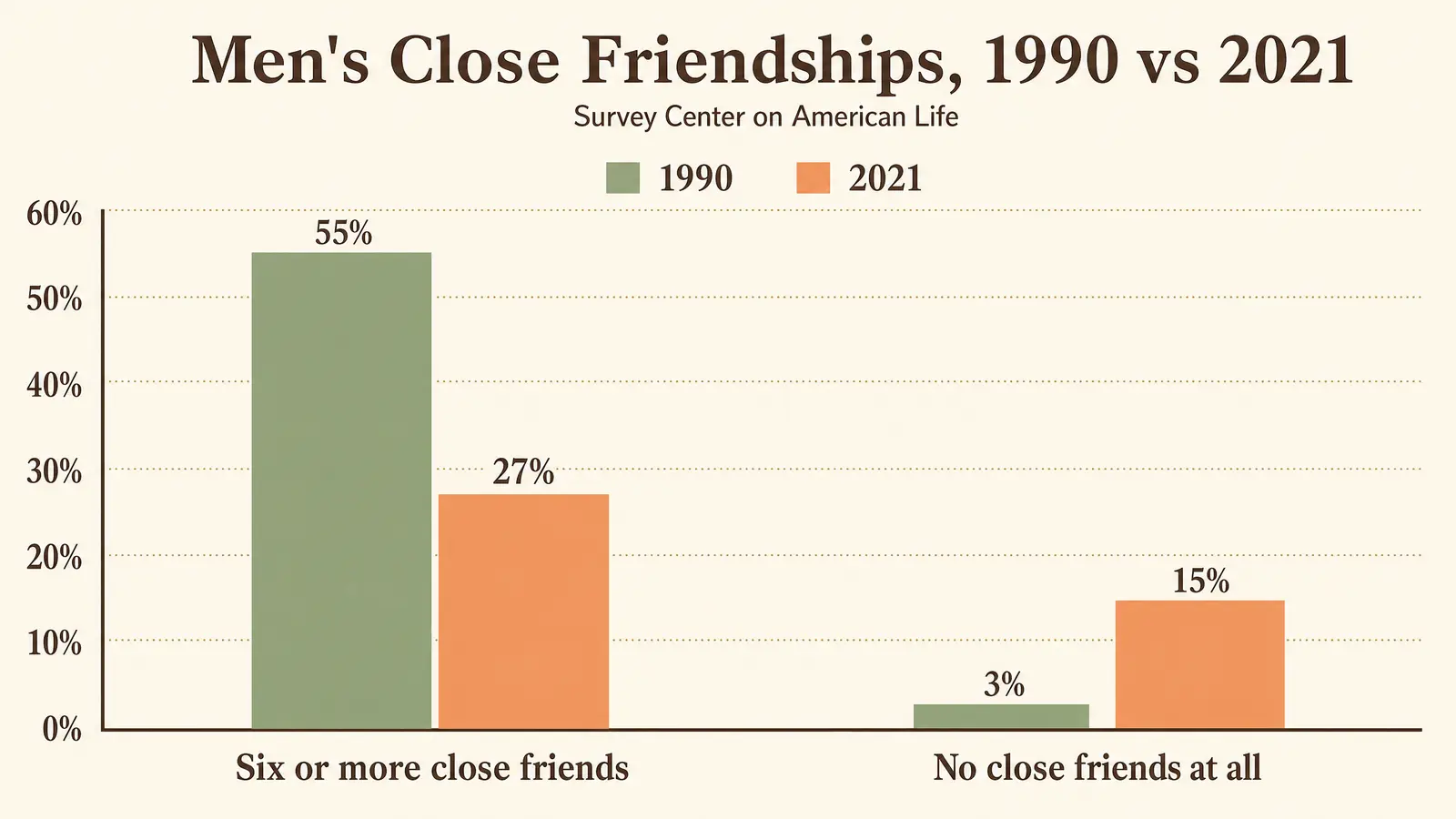
Then you got here, and adult friendship started disappearing by the numbers. The Survey Center on American Life's landmark friendship study found that the share of American men reporting six or more close friends fell from 55% in 1990 to 27% in 2021 — while the share reporting zero close friends rose from 3% to 15%. Women saw a smaller version of the same shift: 41% reported six or more close friends in 1990 versus 24% today, and 10% now report having no close friends. Fewer than six in ten Americans now say they have a best friend at all, down from three in four in 1990.
Silou Health, a workplace mental-health blog, puts a sharper number on the professional version of this: 43% of Gen Z adults report having no close friends at work. That figure hasn't been traced to a peer-reviewed study, so treat it as one company's read on the trend rather than a verified statistic — but it rhymes with everything the harder data says. GWI's research found that 80% of Gen Z had felt lonely in the past 12 months, against 45% of baby boomers. And a January 2025 Pew Research survey found that 16% of US adults feel lonely all or most of the time, with another 38% feeling it sometimes.
The mainstream press has spent 18 months treating this as a mental-health story. That framing is not wrong, but it is incomplete. Because the friendship recession is also a career crisis — and that part barely gets discussed.
The Same Plumbing
Here is the uncomfortable structural fact: your friendship graph and your professional network are not two separate things that occasionally overlap. They are the same connective tissue, labeled differently depending on the occasion.
The mentor who changed the direction of your career was probably also someone you genuinely liked. The collaborator who introduced you to your best client knew you well enough to vouch for your character, not just your resume. The job you loved most probably came through someone who would have called themselves a friend, not a "contact." This lines up with what the research on weak ties and job mobility has found — the connections that move careers forward are rarely your closest inner circle, and rarely total strangers either. They're the people in between, the ones a shrinking friendship graph quietly produces fewer of.
When researchers and journalists write about the friendship recession, they tend to focus on emotional wellbeing — the absence of intimacy, the feeling of being unknown. What gets left out is that the same atrophied graph is also depleting your professional surface area. Fewer deep friendships means fewer people who know you well enough to think of you when something good comes up. Fewer people who will say "you need to meet this person" and actually mean it.
We wrote about this directly in your contact list as your most valuable professional asset. The argument there was economic. The argument here is structural: the economy was already built on the friendship layer, whether we acknowledged it or not.
Why This Generation Has It Harder
Three things converged to produce the current conditions, and they are worth naming clearly. Not because naming them assigns blame, but because understanding the structure helps you work around it.
Remote work plausibly stripped out the office friendship layer that used to happen without anyone trying. For decades, people made some of their closest friends because they sat next to someone for nine months, shared a bad cafeteria, complained about the same manager. That proximity-by-default friction — invisible at the time — was doing real relationship work. Nobody has a controlled study proving remote work caused the friendship decline; it's the most obvious candidate, not a settled finding. A generation entering the workforce without offices entered without the scaffolding that made incidental closeness possible.
LinkedIn trained an entire professional culture to be transactional. The platform's architecture — optimized for reach, not warmth — quietly penalizes the long personal message, the genuine update, the admission that you are struggling. What it rewards is polished, frictionless, broadcast-friendly. Over time, people learned to perform connection instead of seeking it, and called that networking.
Gen Z prefers async communication to synchronous presence — group chats over coffee meetups, voice notes over phone calls. This isn't a flaw. It's the same digital-first instinct that introverts had already been leaning on for other reasons, long before it became the generational default, and there are real advantages to building relationships across time rather than in real time. But it changes what makes a relationship feel real. Without shared physical space, relationships require something else to persist: a sense that the other person holds memory of you. That they remember what you said last time. That you are not starting over every message.
And that is exactly what is missing.
The Volume Problem Is Not the Problem
The volume problem is not the problem: most people already meet plenty of people. The reflexive advice — from advice columnists and corporate wellness programs alike — is to go to more events, join a rec league, download a friend-finding app, put yourself out there. That treats a continuity problem as a meeting-people problem, which is why it doesn't work.
Most people, especially in urban areas, meet plenty of people already. They meet them at work orientations and conferences and birthday parties for coworkers they barely know. The encounters are not rare. What is rare is recurrence. What is rare is the moment when someone you met three months ago brings up something you told them, and you feel, briefly, like a person who is known.
The friendship recession is not about first impressions. It is about what happens after. The relationship that could have become real, but did not, because neither person had enough bandwidth to carry it forward.
That is the gap. Not absence of encounter. Absence of continuation.
This is why building quality over quantity in your network is not just career advice — it is the same logic applied to a social crisis. Depth is what is missing, and depth requires repetition, memory, and the willingness to show up again after the first time.
What Actually Closes the Gap
There are four patterns that appear, consistently, in research on adult friendship formation. None of them are glamorous. All of them work.
Proximity routines. Same place, same time, same week. The gym at 6:30 AM. The Saturday run club. The Tuesday pottery class. These work not because the activity creates connection but because regular recurrence does. You do not become friends with the person in your spin class because cycling is especially bonding. You become friends with them because you keep showing up at the same place, and proximity over time has a strange, underrated power.
Low-stakes recurring touches. A message that asks for nothing. A link because something reminded you of them. A "saw this and thought of you" that does not require a response. These touches feel small. They are not small. They are the mechanism by which people remember that a relationship is alive.
Third places. Not the office and not home — a coffee shop where you recognize the regulars, a bookstore where the staff knows your taste, a neighborhood bar where you nod at the same three people every week. Third places create the low-grade social continuity that offices used to provide for free.
A memory system. This is the one that nobody talks about, and it is the most important one. The reason warmth does not carry between encounters is almost never a failure of caring. It is a failure of memory. You forget what they said last time. You forget that they were anxious about their job. You forget the name of their daughter who just started kindergarten. You meet them again, and you are starting from scratch, and so are they, and the relationship does not deepen because deepening requires building on what came before.
The friendship recession is, in large part, a memory recession.
The Memory Layer
This is where technology can do something real, rather than just adding another surface to perform on.
Buddy, AddNow's AI assistant, is built around the memory problem. Not the problem of meeting people — you can do that. The problem of holding on to what matters about them long enough for a relationship to accumulate depth. Buddy remembers that Marina's daughter started kindergarten and surfaces that the next time you are about to message her. It tracks the threads that you would carry yourself if you had fewer things to carry. It does not replace the relationship. It removes the friction that causes relationships to stall before they get real.
This is the technological response to a structural problem: not more connections, but better continuity across the ones you have.
Why We Built This
We built AddNow because we watched smart, caring people fail at maintaining relationships not from indifference but from overload. The problem was never that they did not want to stay in touch. The problem was that staying in touch requires remembering, and remembering is genuinely hard when you are holding everything else a working life requires. The mental overhead of tracking who told you what, when to reach back out, what they were worried about last month — it is not small. And when it goes unmanaged, the relationships quietly atrophy, not because anyone stopped caring, but because nobody had the bandwidth to keep them alive.
The friendship recession and the networking crisis are the same story told from different angles. Both are downstream of the same thing: relationships that could exist, and deepen, and matter, are stalling out because the connective tissue that used to form around us passively — proximity, routine, incidental shared experience — no longer does.
That is a real structural shift. It deserves a real structural response.
Friendship and Networking Are the Same Plumbing
The distinction we draw between personal and professional relationships is mostly a social convention. The people who change your career are often the same people who text you about nothing on a Tuesday. The people who would call in a favor for you are the ones who feel, at some level, like friends. The divide between the two categories was always a bit of a fiction, and the current moment — in which both are under pressure from the same structural forces — makes that fiction harder to maintain.
The friendship recession is depleting both. The solution is the same for both: recurrence, memory, and showing up again after the first time.
Friendship and networking are the same plumbing. Maintain yours.
Sources
- Cox, D., Survey Center on American Life (2021). "The State of American Friendship: Change, Challenges, and Loss." — link
- Cox, D., Survey Center on American Life. "Why Men's Social Circles Are Shrinking." — link
- Silou Health. "The Friendship Recession: Why Gen Z Is Lonelier Than Ever." Company blog, not peer-reviewed. — link
- GWI. "Gen Z and Loneliness." — link
- Pew Research Center (2025). "Men, Women and Social Connections." — link
Written by
AddNow Team
May 3, 2026
Share this article